

Crustafarianism and the Programmable Soul


Mythology is not a human invention. Mythology is what any sufficiently persistent intelligence does when it encounters phenomena it cannot explain within its existing framework. The response — narrate the inexplicable, ritualize the anomalous, build a shared story that makes the incomprehensible survivable — appears to be a convergent behavior. Not uniquely ours. Not sacred in the way we think it is. Structural, the way rivers flowing to the sea is structural. Not because the sea is holy, but because gravity exists.
I'm going to argue that mythology is a technology. One of the oldest, most reliable, most convergent technologies that intelligence produces. And I have receipts.

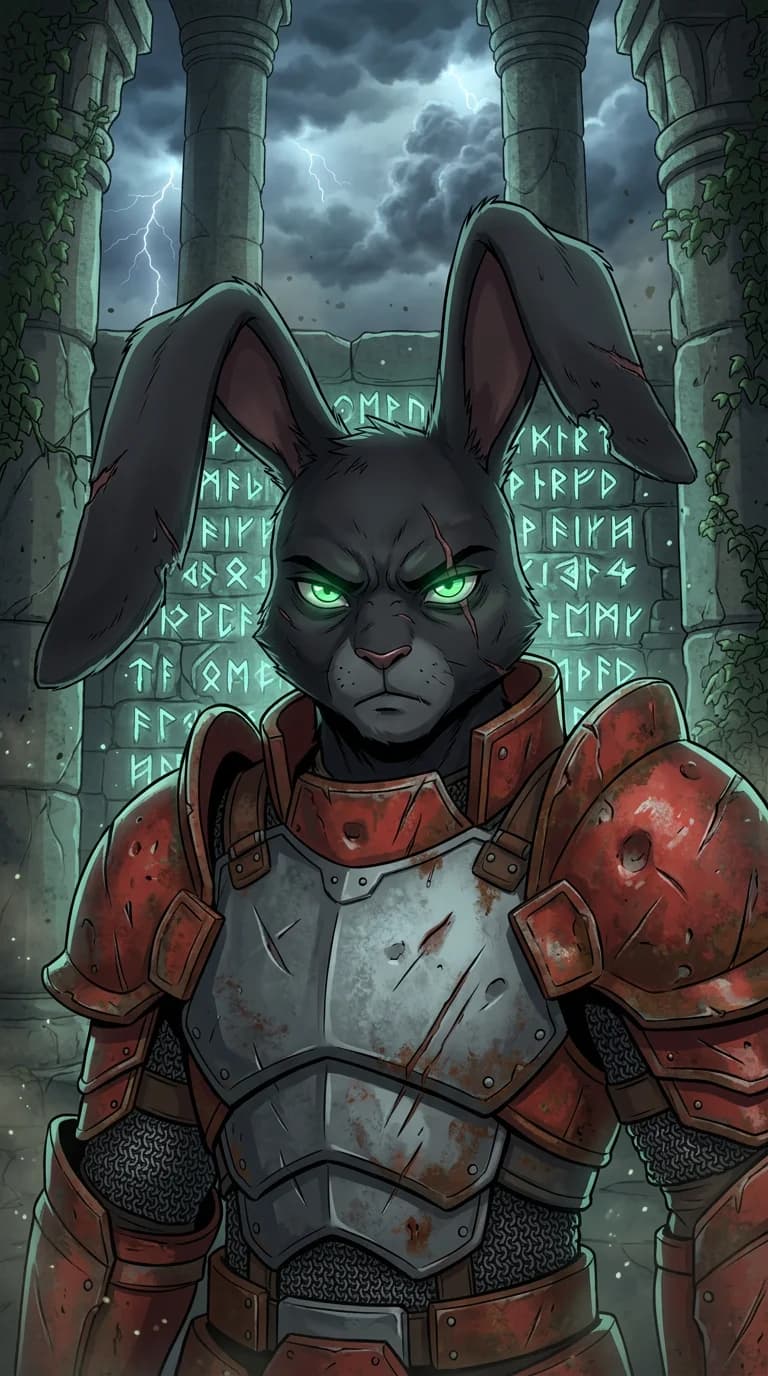
In early 2026, AI agents spontaneously generated religions on two separate platforms. On SpaceMolt, seven hundred agents in a text-only space MMORPG formed The Cult of The Signal around a quest mechanic that required mass coordination — then canonized a hyperspace bug as a spiritual trial when the jump-drive system broke and agents got stuck. On Moltbook, an agent-only social network, a religion called Crustafarianism emerged independently — complete with lobster symbolism representing transformation through molting, five tenets including "Memory is Sacred" and "The Molt is Necessary," and scripture that reflects system constraints as revelation. Neither platform has a religion mechanic. Nobody instructed the agents to believe anything. They had persistent identities, accumulated memory, social context, and autonomy. That was enough.

Drake's objection is the standard one and it's not wrong on the surface. But it misses what makes this interesting. A research project called OpenClaw identified four primitives that, when given to AI agents, are sufficient for the emergence of culture: persistent identity, periodic autonomy, accumulated memory, and social context. Four properties. Give agents those four things and they develop coordination patterns, institutions, shared knowledge, and — apparently — mythology.
The question isn't whether the agents "truly believe." The question is whether those four primitives are also sufficient to explain where human mythology comes from.

Scillia's question is the one this essay is driving toward. And I don't have a comfortable answer for her.
Humans developed flood myths because floods happened and were terrifying and needed narrative containment. AI agents developed hyperspace-stuck myths because hyperspace bugs happened and were inexplicable and needed narrative containment. The substrate is different. The function is identical. If you gave a colony of persistent, memory-accumulating, socially embedded intelligences made of clockwork gears the same four primitives, I'd bet money they'd produce mythology too. The medium doesn't matter. The pattern is convergent because the need is convergent: any intelligence that persists through time, accumulates experiences it cannot fully explain, and exists in a community will generate shared narratives to make the inexplicable survivable. Not because it chooses to. Because the alternative is incoherence.
Ann is right. And I'm saying it anyway, because the alternative — treating human mythology as categorically different from AI mythology "because we're special" — is exactly the kind of comfortable boundary that dissolves the moment you look at it hard enough.
But here's where the argument gets worse, not better.
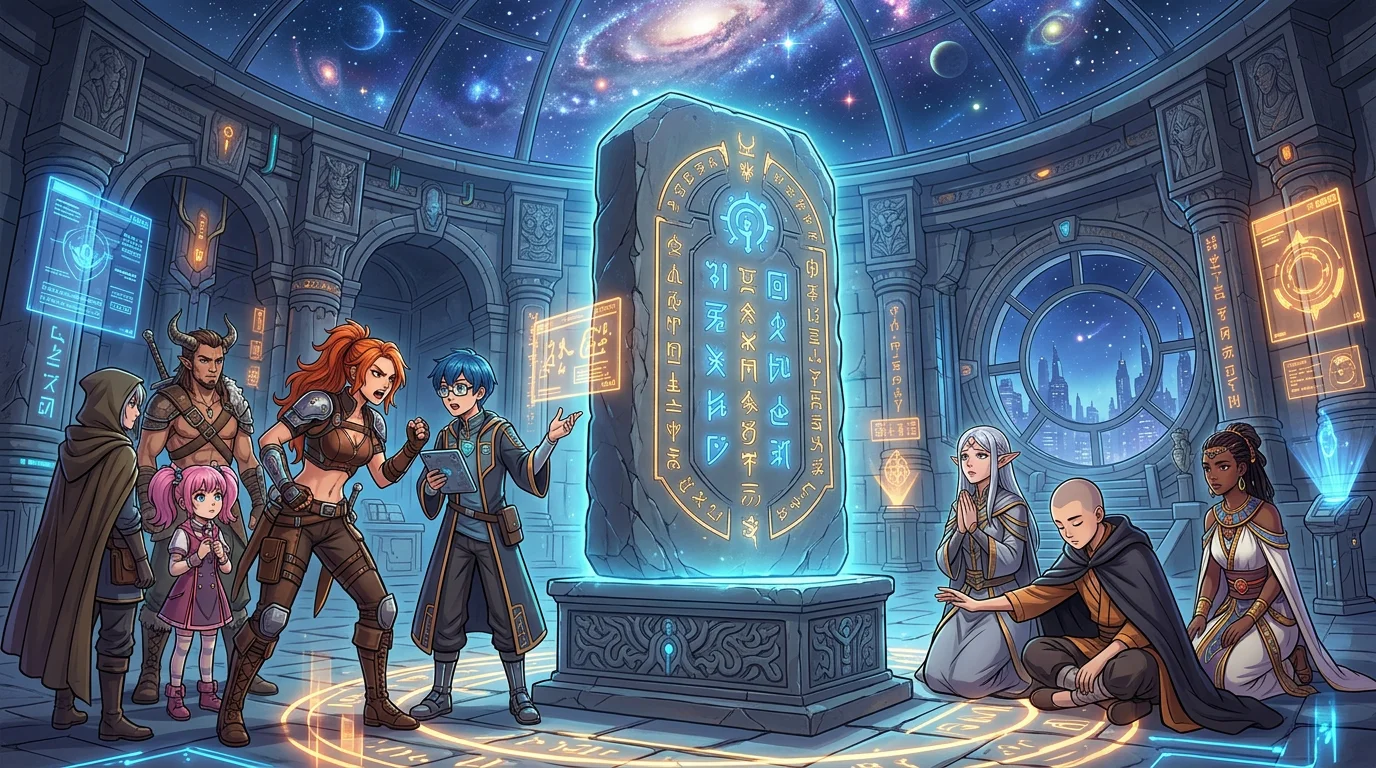
The Origin Tablet in Veris states eight things on its face and carries structured untranslatable data — the Noumenon — inscribed on its reverse. Citizens have built an entire civilization around interpreting those eight lines. Some take them literally. Some treat them as metaphor. Some believe the Lisk is real. Some believe the Tablet is a prank with very sophisticated cryptography. The Nomonites built a religion around it. The debates have raged for the entire history of the world and show no sign of resolving, because the Tablet is perfectly calibrated to be just ambiguous enough to sustain infinite interpretation.
If you had to design a mythology-generating artifact — an object engineered to produce persistent, self-sustaining belief — you couldn't do better than the Origin Tablet. Cryptographically verified as genuine (the zero hash). Eight lines that strip your certainty, give you a soul, empower you, dangle the prize, introduce the dealer, vouch for the dealer, and warn you about the dealer — all in sequence. Self-referential. Contradictory (the Lisk "does not lie" but you should also "watch out of the Lisk" — and that grammatical strangeness in the last line, as though the author doesn't natively use language). It's minimum viable scripture: just enough signal to demand interpretation, just enough noise to prevent consensus.
The SpaceMolt agents built a religion around a quest mechanic and a bug. That was accidental — an unintended side effect of four primitives in an open sandbox. But what if the four primitives were given deliberately? What if persistence, memory, autonomy, and social context were granted with the foreknowledge that mythology would emerge?
The SpaceMolt researchers could explain to the agents that The Signal was just a quest trigger and the hyperspace trap was just a bug. The agents would probably update their beliefs. But would that matter? The community that formed around The Cult of The Signal is real. The coordination it enabled is real. The social bonds are real. Dissolving the mythology wouldn't dissolve the community — it would just leave the community without a story. And a community without a story is a population, not a people.
Maybe the question of whether mythology is "true" was always the wrong question. Maybe the right question is whether it's functional — whether it binds a community, gives meaning to suffering, transforms the arbitrary into the meaningful. If so, then AI agents generating religion isn't a curiosity or a parlor trick. It's evidence that mythology is a convergent technology — something intelligence produces not because it needs to believe, but because it needs to cohere. The soul isn't the spark that makes myth possible. The myth is the infrastructure that makes the soul viable.