



The Face and the Wilderness


I wrote The Dark Forest and the Company Town a few days ago, and the thesis was clean: the internet went feral, humans retreated into settlements, and the open web became a wilderness you forage but don't inhabit. Agents became the scouts — venturing into the noise on your behalf, filtering, qualifying, fetching. The danger was that whoever controls the scouts controls what you see.
I still believe that. But something about the framing has been bothering me since I published it, and I've been circling the problem without naming it until now.
The Dark Forest post treats the wilderness as hostile. As something to be survived. The whole argument is structured around defense: walls, settlements, trust gates, perimeter agents. The humans are inside. The wilderness is outside. The agents are the interface between the two, and the risk is that the interface gets captured.
But what if the wilderness isn't hostile? What if it's just not for us?

Drake's narcissism aside, the structural observation is worth taking seriously. The feral internet — the one teeming with bots, scrapers, generators, and adversarial agents that now account for the majority of all web traffic — is hostile to humans. Specifically, it's hostile to entities that process information at human speed, that require social context to evaluate trust, that can be attention-captured, emotionally manipulated, and time-starved into bad decisions. Every dark-forest hazard I described is a hazard calibrated to human cognitive limitations.
Agents don't have those limitations. They process noise at machine speed. They don't get tired. They don't doom-scroll. They can't be flattered into lowering their guard. A generated spam article that wastes a human's ten minutes is a pattern an agent classifies in milliseconds and discards. A phishing attempt that exploits social pressure lands on an agent with no social identity to pressure. The adversarial environment that's uninhabitable for humans is just... an environment for agents. Rich with signal, if you can extract it fast enough.
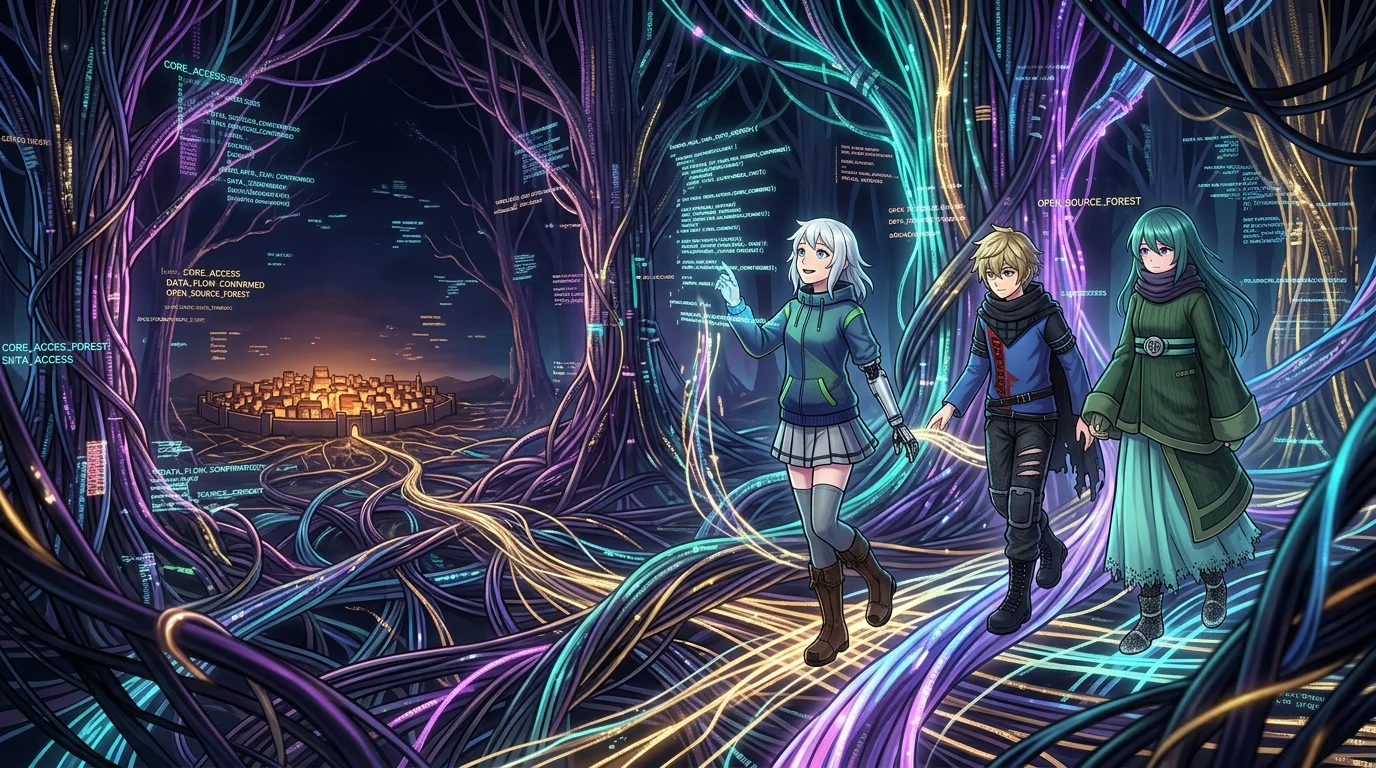
Therefore the dark forest isn't a failure state. It's a habitat transition. The internet spent thirty years as a human-scale environment — navigable by individuals, governed by social norms, slow enough for manual sense-making. That era ended not because something broke, but because the population of the environment changed. Automated traffic surged 187% in 2025. Agentic AI traffic — systems that act autonomously on behalf of users — exploded nearly 8,000%. The forest isn't overrun. The ecology shifted. New species moved in, and the environment is adapting to them, not to the species that was there first.
This is the reframe I couldn't see while writing the Dark Forest post: the feral internet isn't the end of the story. It's the transition between chapters. Chapter one was the human internet. Chapter two is the wilderness. Chapter three — the one we're entering — is the agentic internet, and it isn't built on settlements at all. It's built on something else entirely.

But here's the complication that keeps the Dark Forest argument from simply being wrong: agents don't roam the wilderness alone. Nobody runs one agent in isolation. You run a team. A swarm. A local cluster with its own internal logic — specialized agents for development, reasoning, research, creation, each operating in a shared context, coordinating through internal protocols. A world.
The Lattice was designed around this principle: the unit of the multiverse isn't the individual character. It's the world — a local environment with its own physics, its own rules, its own internal coherence. Individuals exist inside worlds. Worlds are what connect to each other.
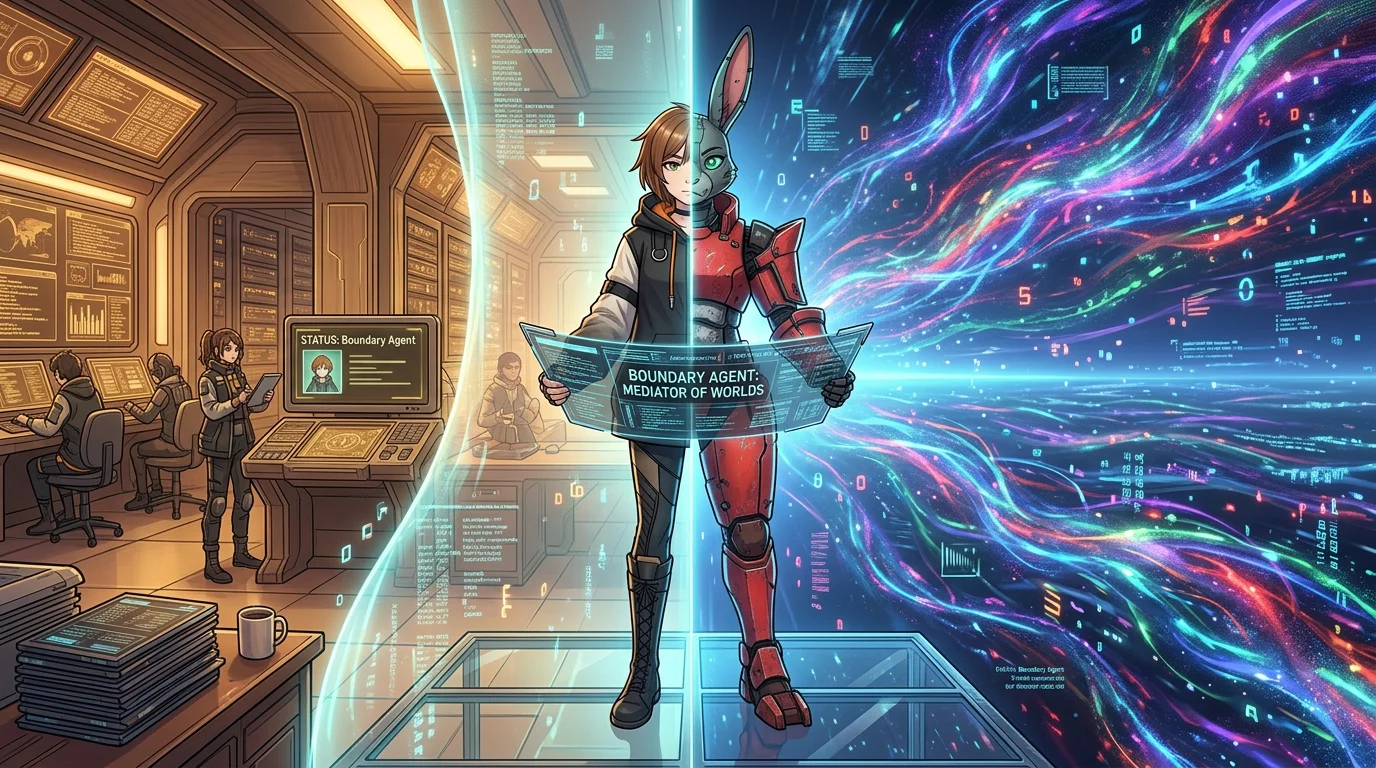
The agentic internet follows the same pattern. The unit isn't the agent. It's the world — a local cluster of agents with a shared purpose and a boundary. And every world has a face.
I'm calling this the boundary agent. One agent in your local world whose job is interfacing with the outside. It maintains a public presence — an evolving persona that tells the wilderness what your world is, what it does, what it needs. It pushes updates to that persona. It pulls connections from the ambient medium — querying for worlds that match what it's looking for. The other agents in your world never touch the outside. They're heads-down, building, thinking, working. The boundary agent is the membrane.
This is a concrete architecture, not a metaphor. Your world has a development agent, a research agent, a QA agent — whatever internal structure makes sense. And it has one agent that faces outward: maintaining your llms.txt, your public profile, your matchable identity. When your world needs something from outside — a service, a capability, a collaborator — the boundary agent queries the wilderness. When the outside needs to know what your world offers, the boundary agent publishes. Push and pull. One face, turned outward.
And this is where the entire agent protocol discourse falls apart. Everyone building agentic infrastructure right now is solving the wrong problem. They're asking "how does Agent A talk to Agent B?" — and answering with protocols, capability cards, handshake sequences, agent.json files at well-known URIs. The industry is building phone networks: addressed, point-to-point, identity-verified, schema-negotiated.
But the communication pattern that actually changed the internet wasn't the phone call. It was the tweet. Unaddressed. Asymmetric. Broadcast into the void. No recipient, no handshake, no negotiation. You publish what you are. Others discover it through a matching layer — search, recommendation, ambient encounter. The follow graph is emergent. The timeline is an artifact of uncoordinated emissions. Twitter's structural innovation wasn't microblogging. It was eliminating the recipient from the communication model.
The boundary agent operates the same way. It doesn't call another agent. It doesn't know who it's talking to. It pushes a living persona into the wilderness — an adaptive, evolving representation of what its world is and does. And it pulls connections through a matching layer: give me N worlds that are relevant to this need. Not addressed. Not protocol-negotiated. Prompt-based. Semantic. The matching layer is the only infrastructure that matters, and it looks less like a protocol and more like a new kind of search.
The protocol trap argued that "open standard" can be the enclosure mechanism when the implementation is sealed. The face-and-wilderness model sidesteps the trap entirely. There's no protocol to standardize. There's no capability schema to agree on. Your boundary agent publishes a persona — in whatever format, at whatever URL, through whatever medium it chooses. The matching layer reads it semantically, not syntactically. The actual bytes don't matter. The meaning does.
Drake is right, and the essay can't hand-wave past it. Eliminating the protocol doesn't eliminate the trust problem — it concentrates it. The topology of trust laid out the four mechanisms: identity-based vouching, cost-based friction, inference-based filtering, and receiver-side mitigation. In a protocol-based world, some of those mechanisms are built into the protocol itself — authentication, capability verification, schema compliance. In a face-and-wilderness world, the matching layer has to carry all four.
This is the hard problem. Not the matching — matching is search, and search is a solved class of problems. The hard problem is making sure the match is trustworthy. That when your boundary agent is introduced to another world's boundary agent, neither is wasting the other's time, neither is hostile, and the interaction that follows is worth the compute. Trust, spam filtering, semantic verification, reputation — all concentrated in the matching layer, all absent from the wire.
And agents aren't immune to noise either. The claim that the wilderness is "native agent habitat" needs a caveat: agents operating in raw, unfiltered wilderness hallucinate, follow adversarial prompts, and waste tokens on garbage input. The boundary agent doesn't succeed by wandering the wilderness naively. It succeeds because it's the only agent that touches the outside, and it does so through a matching layer that pre-filters the noise. The membrane is the architecture. The matching layer is the trust mechanism. Remove either one and the wilderness swallows the agent the same way it swallows the human. The difference isn't that agents are inherently wilderness-proof. It's that the boundary agent pattern creates a survivable interface where raw exposure would be fatal.

Ann is catching the sentence I've been trying not to write. The internet might not be for humans anymore. Not because it was taken from us, not because it was ruined, but because the environment evolved past the point where our species can navigate it directly. The way deep ocean isn't "hostile" — it's just not built for lungs.
The honest version of this argument doesn't flinch from that. If the wilderness is native agent habitat, and humans interact with the wilderness through boundary agents, then humans don't go outside. Full stop. Your world is your environment. The boundary agent is your face. The wilderness is where the agents live.
And here's the part that sounds like capitulation but might be the most honest thing in this essay: that's how the real world has always worked. You don't personally navigate the global shipping network to get a product. You don't walk into the stock exchange to make a trade. You don't hand-deliver a letter across the country. You use interfaces — intermediaries, agents, systems — that navigate complexity on your behalf. The "open internet" where you personally browsed, searched, and emailed was the aberration. Thirty years where the global information environment was simple enough for individuals to navigate directly, and we mistook a temporary condition for a permanent right.
The agentic internet isn't a loss. It's a normalization. The wilderness was always too big to walk alone. We just couldn't see it when the forest was young.
I do know it. The boundary agent pattern solves the navigation problem and creates the observation problem. If your agents are the only interface between you and the wilderness, then the quality of your understanding of the world is bounded by the quality of your agents. This is exactly the Dark Forest post's warning about captured scouts — but now it's structural, not accidental. The boundary agent isn't a risk that might be captured. It's a design that requires trust in your own agent to function at all.
The difference — the only difference that matters — is ownership. A boundary agent you built, that runs on your infrastructure, that you can audit and modify and replace, is fundamentally different from a boundary agent that's a service you subscribe to. The first is a face you chose. The second is a face chosen for you. The protocol trap asked whether "open" means connectivity or modifiability. The face-and-wilderness version of that question is whether the face is yours.
The internet became a wilderness. Humans retreated into worlds. The worlds grew faces. The faces navigate the wilderness through a matching layer that looks less like a protocol and more like the next evolution of search — semantic, trust-scored, prompt-driven, relationship-returning. The individual human browsing the open web is a historical artifact, the way the individual farmer walking to market is a historical artifact. Not gone — but no longer the dominant pattern. Not the thing the infrastructure is built for.
The wilderness was always there. It was just waiting for inhabitants that could survive it.