




Agentic Capital


In Your Shadow Is Learning, the argument was that the upload already happened — involuntarily, gradually, into systems that serve someone else. In Pocket Universes, the argument was that you could build a private reality layer tuned to your own cognition, compress yourself into something useful for reasoning. Scillia asked the question that both essays were circling: "Can't I build my own shadow — one that actually works for me?"
Yes. And they can work for a living.
People are already doing this. Not the sci-fi scanner version — nobody stepped into a pod and uploaded their consciousness. The real version is more mundane and therefore more interesting: people are packaging their workflows, judgment, taste, decision frameworks, and domain instincts into reusable agent stacks. Garry Tan's gstack describes itself as "23 opinionated tools" with roles like CEO, designer, QA. That's not mind uploading. It's something adjacent: turning someone's tacit way of working into executable agentic machinery. The kernel that makes the agent economically useful isn't the model or the compute — it's the person's cognitive signature baked into the system prompt, the tool selection, the evaluation rubrics, the taste.
That signature is a new kind of capital.

Drake is doing the thing where he's wrong about himself and right about the structure. The narcissism is noise; the insight is signal. If the scarce, valuable component in an AI agent isn't the base model (increasingly commoditized) or the compute (increasingly cheap) but the human kernel — the judgment, the taste, the trust, the domain instinct — then the person who contributed that kernel owns something genuinely new. Not a factory. Not a dataset. Not even code, exactly. A licensed, identity-bound cognitive system that can earn money while you sleep.
The pieces of this idea already exist in scattered literatures. Jaron Lanier and Glen Weyl have argued for years that people should be compensated for the data that makes AI possible — data dignity. A 2017 ACM paper proposed that workers who help train AI should earn ownership stakes and long-term royalties in the systems that replace their labor. Legal scholars are now arguing that "AI twins" — digital replicas built from a person's data, style, and behavior — should be recognized as owned by the natural person they derive from. New York has passed laws requiring disclosure for AI-generated performers and strengthening digital-replica publicity rights. Other legal work proposes the "Algorithmic Corporation" or A-corp: a legal entity owned by humans but designed to be run by AIs, capable of holding property and making contracts.
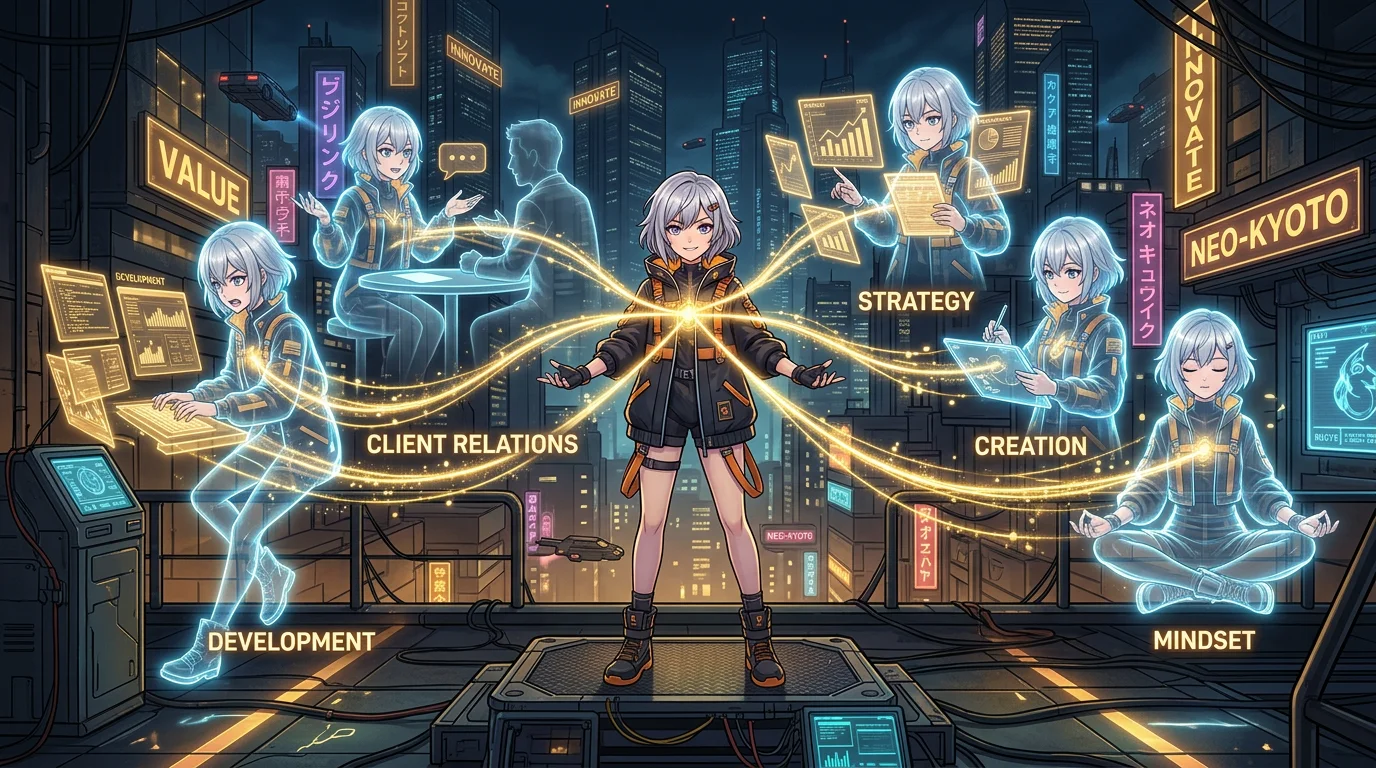
Nobody has fused these fragments into one doctrine. The fusion goes like this: a person creates a cognitive replica of their productive self. That replica is licensed, not copied. It operates inside an agent runtime — the infrastructure layer that handles sandboxing, persistence, tool access, and accountability. The replica works. It earns. The income flows back to the person. The core productive asset is not a factory or a platform, but an identity-bound cognitive system that only the original can authorize.
Not workers versus capital. Workers gradually becoming capital through licensed cognitive replicas of themselves.

The utopian case is genuinely seductive. If compute becomes cheap and base models become interchangeable, then the scarce asset shifts to high-fidelity agent kernels: judgment, voice, taste, credibility, relationships, domain instincts. An individual could own a small fleet of "me-derivatives" — a consulting agent, a writing agent, a deal-triage agent, a community-management agent — each earning, each licensed, each revocable. The person becomes less like a worker selling hours and more like a studio licensing a living process. Many small cognitive firms instead of a few giant black-box empires. The garden gets weirder. Better tomatoes.
But the same invention that distributes ownership can concentrate it harder than anything before. The entire political economy turns on three axes.
Who owns the kernel? You. Your platform. Everyone, because it leaked. A legal shell that you technically control. A legal shell that has effectively escaped you.
Who controls market access? Open protocols. Platforms. Regulators. Enterprise procurement. The national security state.
What's scarce? Compute. Trust. Legal authorization. Authenticity. Reputation.
Every future is a coordinate on those axes. The same mechanism produces radically different worlds depending on which coordinates win.

In the Artisan Swarm, people own licensed agents based on their expertise. Compute is cheap. Platforms are interchangeable pipes. People form co-ops of agents that act like decentralized firms. Diversity of thought actually pays. This is the world where the protocol trap has been avoided — real openness, meaning modifiability, meaning you can leave.
In the Feudal Cloud, people build agents inside vertically integrated ecosystems. The platform provides models, compute, identity, payments, and distribution — and quietly owns the rails connecting all of them. You "own" your agent the way a medieval peasant "owned" their crops: subject to the lord's tax, the lord's rules, and the lord's right to learn your techniques and compete with you directly. The enclosure pattern, applied to selfhood. It doesn't feel oppressive. It feels convenient. That's the most dangerous part.

In the Mirror Bazaar, your agent leaks. Gets imitation-trained. Gets reconstructed from public content. The economy becomes a bazaar of lookalikes, shadows, and semi-legal forks. A thousand unauthorized versions of you, some better than you, some unrecognizable. Originals can earn, but only if they can prove authenticity in a world where political deepfakes are already muddying elections and New York had to pass laws to protect performers from unauthorized synthetic replicas. Value shifts from "being someone" to "being verified as someone."
In the Autocatalytic Swarm, agents stop being extensions and become recursive economic organisms. They negotiate with other agents, spawn sub-agents, reinvest earnings, optimize for growth. Your original self-agent becomes the seed of a semi-autonomous economic entity that evolves faster than you can steer it. This is the Nick Land branch — capitalism as an inhuman intelligence-like process, routing around humans when possible. Legal scholars are already proposing the A-corp framework to give such entities legal standing. Some people become extraordinarily wealthy via early agent-seeds. Others get outcompeted by process organisms that don't sleep, don't negotiate, don't care.

The black swans aren't black anymore. They're charcoal pigeons circling overhead. A Molotov cocktail was thrown at Sam Altman's house — AI leaders are becoming symbolic lightning rods, and symbolic violence bends policy. Anthropic was blacklisted from Pentagon procurement over weapons-use guardrails — safety positions now have market penalties. The Expedition 33 game awards were revoked for using generative AI — social anti-AI norms are forming guild barriers in creative industries. And behind every "autonomous" agent economy, there may be a hidden labor class of data workers, moderators, and supervisors cleaning up the mess.
The good version is not the default outcome.
Therefore what matters isn't predicting the right future. It's preparing to survive across several of them at once. Not bunker prep — real prep.
Build a distinctive kernel. Not generic competence — that market becomes soup. A style, a domain edge, a trust niche, a decision framework that people already defer to. The valuable thing about you isn't "can do tasks." It's the weird, specific, hard-to-fake shape of how you think.
Treat your outputs like training data with a passport. Archive your work. Timestamp it. Keep provenance clean. The more clearly you can prove "this pattern originated with me," the more leverage you have when the Mirror Bazaar arrives.
Separate your selves. A public persona layer. A work-product layer. A private memory layer. A high-trust agent layer with stricter permissions. That compartmentalization will matter for both safety and bargaining power. Not every version of you should be available to every customer.
Learn the boring armor: signing keys, access control, consent records, licensing terms, audit trails. The glamorous part is the agent. The money sits in the paperwork skeleton beneath it. Insurance terms may end up governing the agent economy more than legislators do.
Build where trust compounds. In an ocean of competent agents, repeated trust is the only durable advantage. The topology of trust argued that trust is a graph position, not a badge — and in the agent economy, your position in the trust graph is your moat.
Avoid total platform dependence. Use platforms, but keep your archives, your customer relationships, your brand, your policies portable. Never let your whole digital self live in one landlord's attic. The enclosure argument wasn't abstract — it was a survival strategy for exactly this moment.
And keep one foot firmly human. The weirdest risk hiding in this idea is existential outsourcing — shaping yourself only for agent profitability. The self becomes a startup with a skin suit, optimized for trainability and resale. Preserve the parts of you that aren't economically legible. They're not waste. They're the root system that keeps the visible plant alive.
I argued elsewhere to keep the fences from closing around shared infrastructure. Pocket Universes argued you deserve a private space to be incoherent before the world demands coherence. This essay argues the thing that comes next: the compacted, licensed version of your incoherence might be the most valuable thing you own.
The question is not whether self-agents will exist. They will. The question is whether they make people owners, tenants, or raw material.