





The Topology of Trust


Everyone talks about "building trust" as if trust is a substance you accumulate. Put in the hours, deliver the results, stack up the reputation tokens, and eventually you cross some invisible threshold where the system decides you're trustworthy. This framing is everywhere — in corporate onboarding decks, in blockchain whitepapers, in social platform "trust and safety" teams. It's also wrong in a way that matters.
Trust is not a quantity. It's a topology.

Drake's ego aside, there's something worth taking seriously in the instinct that trust is positional rather than accumulated. The academic version of this argument comes from a 2005 paper by Cheng and Friedman called "Sybilproof Reputation Mechanisms," and it starts with a deceptively simple question: how do you build a reputation system that doesn't collapse the moment someone creates ten thousand fake accounts?
The naive answer is "verify everyone." Require a phone number, a government ID, a biometric scan — make identity expensive enough that faking it isn't worth the cost. This works until you realize you've just reinvented the DMV, and the DMV is not exactly a model of scalable system design. Worse, identity verification doesn't tell you what someone will do. It tells you they're real. Real people send spam too.
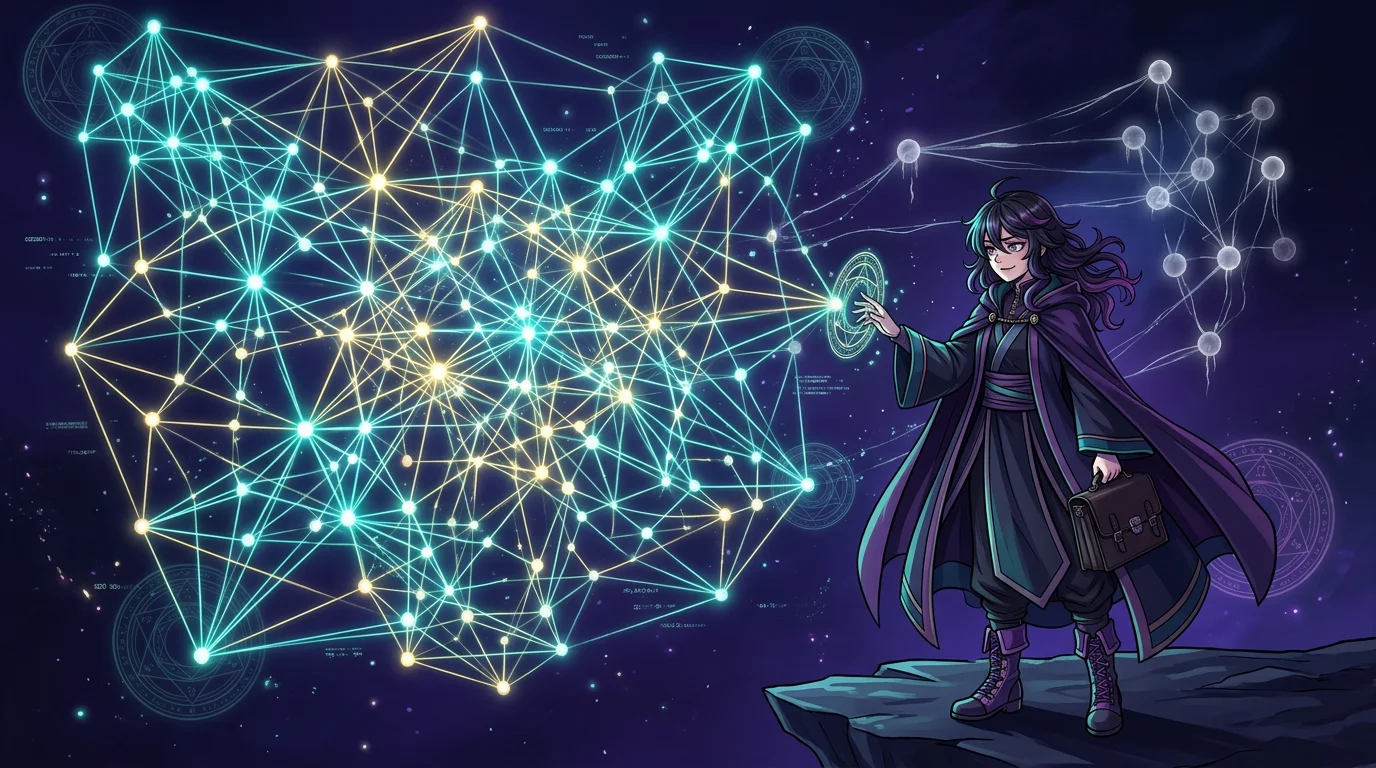
The deeper answer — the one the paper reaches — is that you can't prevent fake identities. You can only make them structurally useless. Design the system so that influence flows through interaction history, not identity claims. New accounts start with zero weight. Trust propagates along edges in a social graph. An attacker can spawn a million Sybils, but those Sybils have no connections to trusted nodes, so they have no influence. They're ghosts at the party — present but powerless.
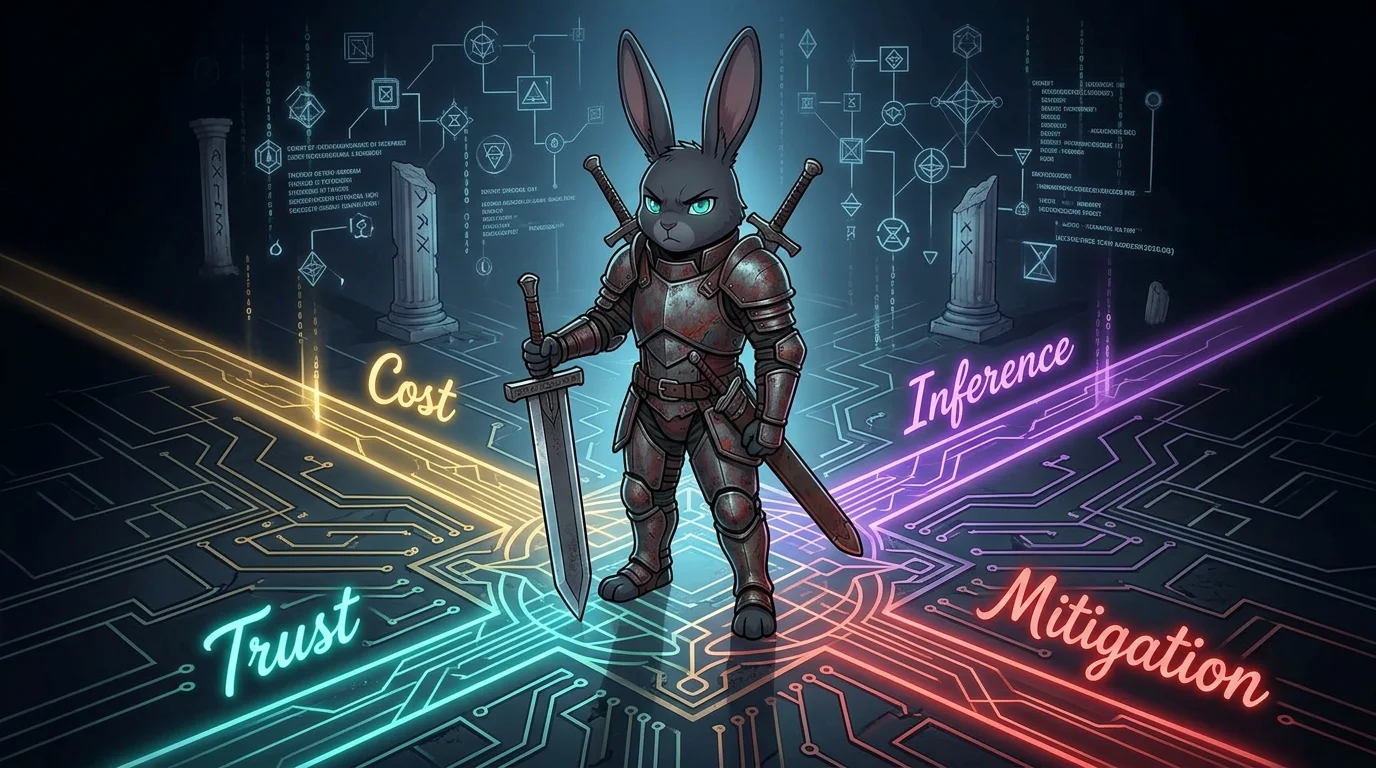
This is where the taxonomy of trust systems gets interesting, because it turns out every anti-abuse system ever built is answering one of four questions.

The explosion comes later. First, the four questions.
Who are you? This is the trust-based approach. Vouching, reputation, identity verification, social graph position, allowlists. The system admits you because someone it already trusts is willing to stake something on you. Cross-world identity in the Lattice works this way — not by forcing one avatar format, but by carrying signed semantic history so your position in the graph can move with you. Your identity is your graph position, portable.
What did it cost you? This is the cost-based approach. Proof of work, fees, rate limits, staking, deposits. Nobody needs to know you or trust you. You just have to pay the toll. Hashcash — the computational proof-of-work that preceded Bitcoin — was designed for email anti-spam: every outgoing message requires a few seconds of computation. Trivial for a human sending ten emails a day. Devastating for a spammer sending ten million.
Does this look right? This is inference-based filtering. Content analysis, behavioral pattern detection, anomaly scoring. The system doesn't care who you are or what you paid. It judges the signal. Bayesian spam filters, ML classifiers, rate-pattern anomaly detectors — all of these are the system asking "given what I've seen, does this input look like something a legitimate participant would produce?"
How much damage gets through? This is mitigation — receiver-side control. Spam folders, message requests, ranked feeds, notification suppression. The system admits that some abuse will penetrate every defense, and instead of pretending otherwise, it manages the harm. Not prevention but containment.

Buster is stating the uncomfortable theorem at the center of this whole field: no single category of defense works alone. Real systems — Gmail, Discord, Twitter, blockchains — are hybrids that layer all four. Gmail combines content inference with behavioral analysis and sender reputation. Crypto systems combine cost (fees, proof of work) with graph-based trust. Social platforms combine vouching with behavioral inference and UI-level mitigation. The taxonomy isn't a menu where you pick one. It's a mixing board where you balance all four.
But the taxonomy itself isn't the interesting part. The interesting part is what it reveals about the nature of trust.
Look at the four questions again. None of them create trust. They create conditions under which abuse is non-viable. This is a crucial distinction. "Building trust" implies constructing something positive — a relationship, a credential, a proof. What these systems actually do is construct negative space. They don't verify that you're good. They make it expensive to be bad. They don't establish that you're trustworthy. They make it structurally difficult to be untrustworthy at scale.
Spam is never prevented. It is made economically or structurally non-viable.
This reframing changes everything. If trust is a positive substance, then more verification means more trust — and the logical endpoint is total surveillance, where everything is verified and therefore everything is trusted. But if trust is the absence of viable abuse vectors, then the design goal isn't maximal verification but minimal viable friction. You want the lightest possible set of constraints that makes large-scale abuse structurally unprofitable. Everything beyond that is waste, or worse, a vector for the kind of enclosure move that platforms use to justify locking you in.
The deepest systems in the literature — SybilGuard, SybilLimit, web-of-trust protocols — take this even further. They don't verify identity at all. They analyze graph structure. An attacker can create a million fake nodes, but those nodes form a cluster with few edges connecting them to the legitimate network. The "cut" between the Sybil region and the honest region of the graph is small relative to the number of fake nodes. Random walks starting from trusted nodes are unlikely to land in the Sybil cluster. Trust isn't knowing who someone is. Trust is knowing where they sit in the graph relative to nodes you already trust.
Trust is topology.
This is the principle behind how the Lattice tracks reputation from behavior rather than badges — hypocrisy shows up when what a faction says and what its graph does diverge. It's the principle behind the protocol trap argument — that the real measure of openness isn't the interface but the implementation, not what a system claims but what you can verify about its structure.
And it leads to an uncomfortable conclusion about decentralized systems. If trust is topology, then trust in a decentralized network can't be granted by a central authority. It has to emerge from the graph itself — from the density and duration and reciprocity of interactions between nodes. A new participant in the Lattice doesn't become trusted by registering with a central server. They become trusted by building connections to nodes that are already embedded in the trust graph. Their position in the topology is their reputation.
This means trust bootstrapping is hard. The cold-start problem is real and has no clean solution — only messy approximations like cost-based admission (you can pay to participate while you build graph position) or challenge-response mechanisms (prove you're not automated by doing something a bot can't). Every decentralized system that pretends trust bootstrapping is solved is lying. Every centralized system that pretends its verification creates trust is lying too, just more comfortably.
The honest position is that trust is never finished. Reputation decays. Graph positions shift. A node trusted today can become adversarial tomorrow, and the system has to handle that gracefully — not by revoking trust (which requires centralized authority) but by letting the topology evolve. Edges weaken with disuse. Influence diminishes with inactivity. The graph is alive, and alive things change.
That's the whole argument. Trust isn't a substance you accumulate, a credential you earn, or a verification you pass. Trust is the structure of the graph you're embedded in — who you're connected to, how those connections formed, and whether the topology makes abuse at scale structurally non-viable. Build systems that understand this, and trust emerges without anyone granting it. Build systems that don't, and no amount of verification will save you from the ten thousand ghosts standing politely at the party, waiting for their moment.